Custom Preloader Icon
0%
Dr. Gopal Dorai Ph.D

Change Starts Here

Backed by decades of research and real-world experience, Dr. Gopal Dorai Ph.D shares proven frameworks to help you decide with confidence and live without regret.
BOOK

The Book provides a well-researched, thought-provoking, instructive, and fascinating exploration of all aspects of decision-making.

Written in elegant and jargon-free language, the Book outlines the various steps and strategies you can adopt in your decision-making endeavors.

Readers will welcome as well as enjoy reading about the scores of examples, anecdotes and case studies describing various types of decisions being made by people from different walks of life. Their goals, priorities and the rationale for those choices will engage the reader’s attention.

The over-arching message of this Book is that your decisions and their consequences will have a profound impact on your overall Quality of Life.

You will not only cherish but would want to have this Book on your bookshelves for years to come.

Decisions for Living is a powerful and thought-provoking guide that dives deep into one of life’s most defining forces — the power of choice. With clarity, wisdom, and purpose, this book reminds readers that every stage of life is shaped by the decisions we make and the courage we bring to each turning point.

What sets this book apart is its balanced blend of practical insight and profound reflection. It doesn’t just tell readers to “make better decisions” — it teaches them how to cultivate the mindset, discipline, and awareness necessary to make choices that align with their goals and values. Through its concise yet impactful approach, Decisions for Living serves as both a mentor and motivator, guiding readers toward intentional living and personal mastery.

Whether you are standing at a crossroads, seeking clarity in your career or relationships, or simply striving to live more purposefully, this book offers timeless wisdom for navigating life transitions with confidence. It’s not just a book about making decisions — it’s a roadmap for becoming the person who makes them well.

In essence, Decisions for Living is an inspiring manual for those who believe that change begins within, and that every thoughtful choice carries the potential to shape a better, more fulfilled life.

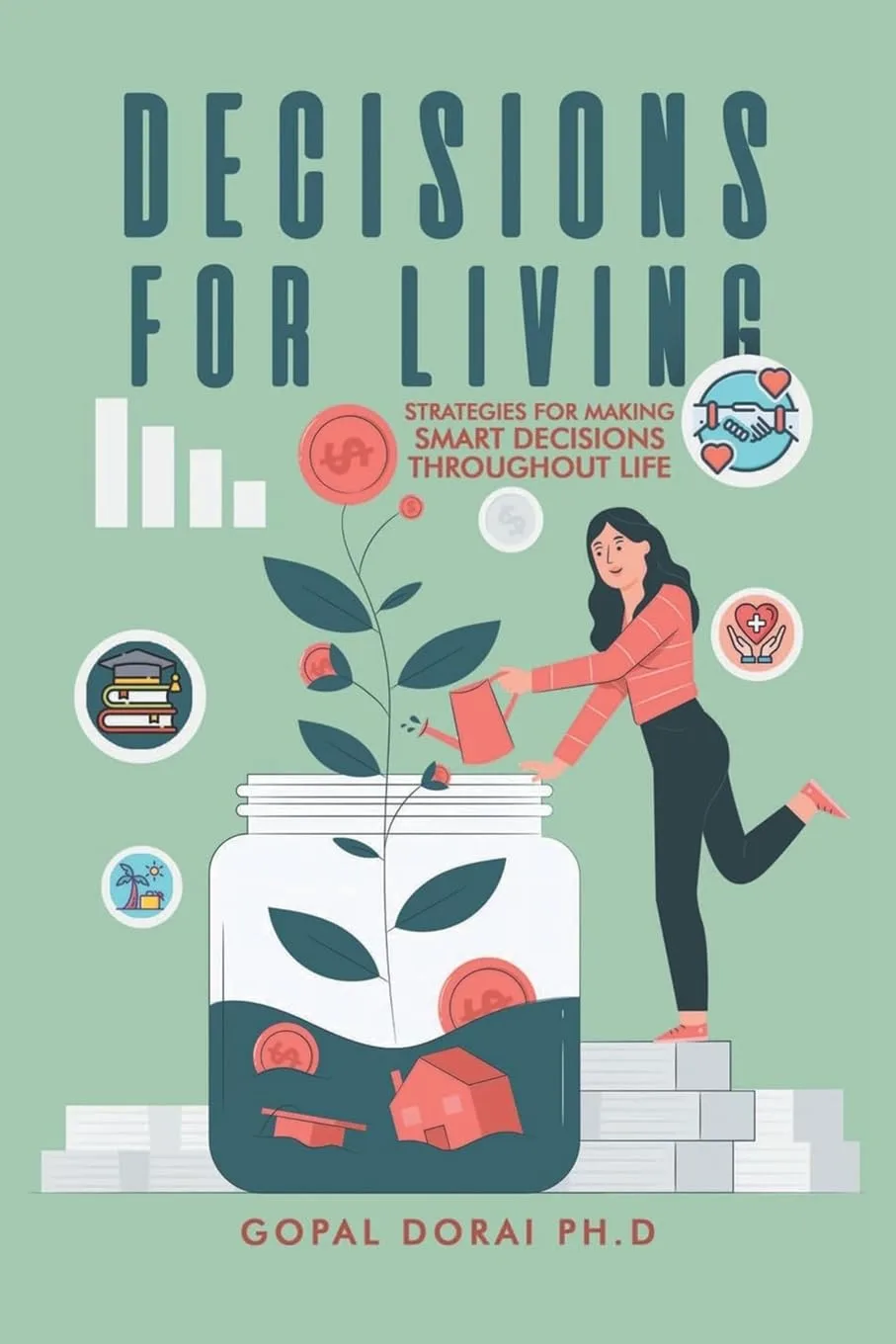
Decisions for Living: Strategies for Making Smart Decisions Throughout Life.

Dr. Gopal Dorai with Benji Cole from CBS Radio on People of Distinction

The Author

DR. GOPAL DORAI Ph.D

Gopal Dorai is an Economist and Financial Consultant. He is Professor of Economics (Emeritus) at William Paterson University, New Jersey.  Dr Dorai has authored articles and monographs on various topics in Economics. His specialization is in the areas of International Economics, Human Capital, Labor Migration and Economic Policy.

He conducts seminars on DECISION MAKING TECHNIQUES for various Groups, Businesses, Governmental Bodies (such as NIST) and Financial Institutions.

Professor Dorai has conducted workshops and seminars on topics of general Economic interest to the layman and specialist. He has addressed groups such as Chambers of Commerce, Rotary Clubs and Citizens Advocacy Groups. He is an expert on Finance/Investments and has consulted for Individuals, Businesses and the Media.

Dr. Dorai has published 3 books:

An Autobiography entitled: From Vilayur to Baltimore

An Illustrated Storybook for Children: Giraffes in the Savannah

Decisions for Living: Strategies for Making Smart Decisions Throughout Life.

THE OTHER BOOKS

Your Best Decisions Start Here

You Deserve to Make the Right Call — Every Time

REVIEWS

Kristi Elizabeth

⭐⭐⭐⭐⭐

Decisions for Living by Gopal Dorai Ph.D is one of those rare books that quietly transforms the way you see every choice you make — past, present, and future. As a 48-year-old woman balancing family, a demanding career, aging parents, and the looming reality of retirement, I found this book to be both deeply enlightening and genuinely empowering. This is not a dry academic text. It reads like an honest, thoughtful conversation with a seasoned mentor who has lived through real mistakes, learned from them, and generously wants to pass those lessons on.

Dorai masterfully weaves together economic principles, relatable storytelling, and self-reflective questions to guide readers through the architecture of decision-making. One story that stayed with me was about George, a novice investor who lost a significant sum in a get-rich-quick scheme. His honest post-mortem — examining whether he had done enough research, whether he had been swayed by a persuasive broker, and what emotions were driving him — became a powerful model for how I now evaluate my own choices. That kind of reflective analysis, Dorai shows us, is not just for financial decisions. It is a habit we can apply to every area of life.

One concept that particularly resonated with me was the idea of the “decision gap” — the critical space between recognizing a problem and actually taking action. I used to believe that pausing and letting things linger would eventually bring clarity. Dorai respectfully challenges that assumption, making a compelling case that active, structured evaluation is what truly builds strong decision-making over time.

The post-mortem reflection questions Dorai recommends after any major decision have already become part of my own routine. Questions like “What was the problem? Did I gather enough information? What would I do differently?” have helped me identify patterns in my thinking I had never noticed before — including my tendency to delay seeking help or default to overly cautious choices out of fear rather than wisdom.

The chapters on health and financial decision-making were especially relevant for me as I approach pre-retirement. Dorai’s discussion on how a series of poor early choices can quietly snowball into major life disruptions was a wake-up call that pushed me to get serious about financial planning and simplifying our household.

What I admire most about this book is its humility. Dorai never promises perfect outcomes or magic solutions. Instead, he equips the reader with practical tools — cost-benefit analysis, the learning curve model, and the memorable “good fit” analogy — that make even the most emotionally charged or high-stakes decisions feel manageable and approachable.

This is not a book I will read once and shelve. I have already revisited several chapters, shared excerpts with my adult son, and flagged pages to discuss with my husband. Chapter VII’s Q&A format alone is worth the price of the book — it functions as a quick, practical reference guide you will return to again and again.

Decisions for Living will not eliminate life’s uncertainty. But it will make navigating that uncertainty feel less overwhelming — and a great deal more intentional.


KIRKUS

⭐⭐⭐⭐⭐

A straightforward and practical self-help guide, hampered slightly by bland graphics.

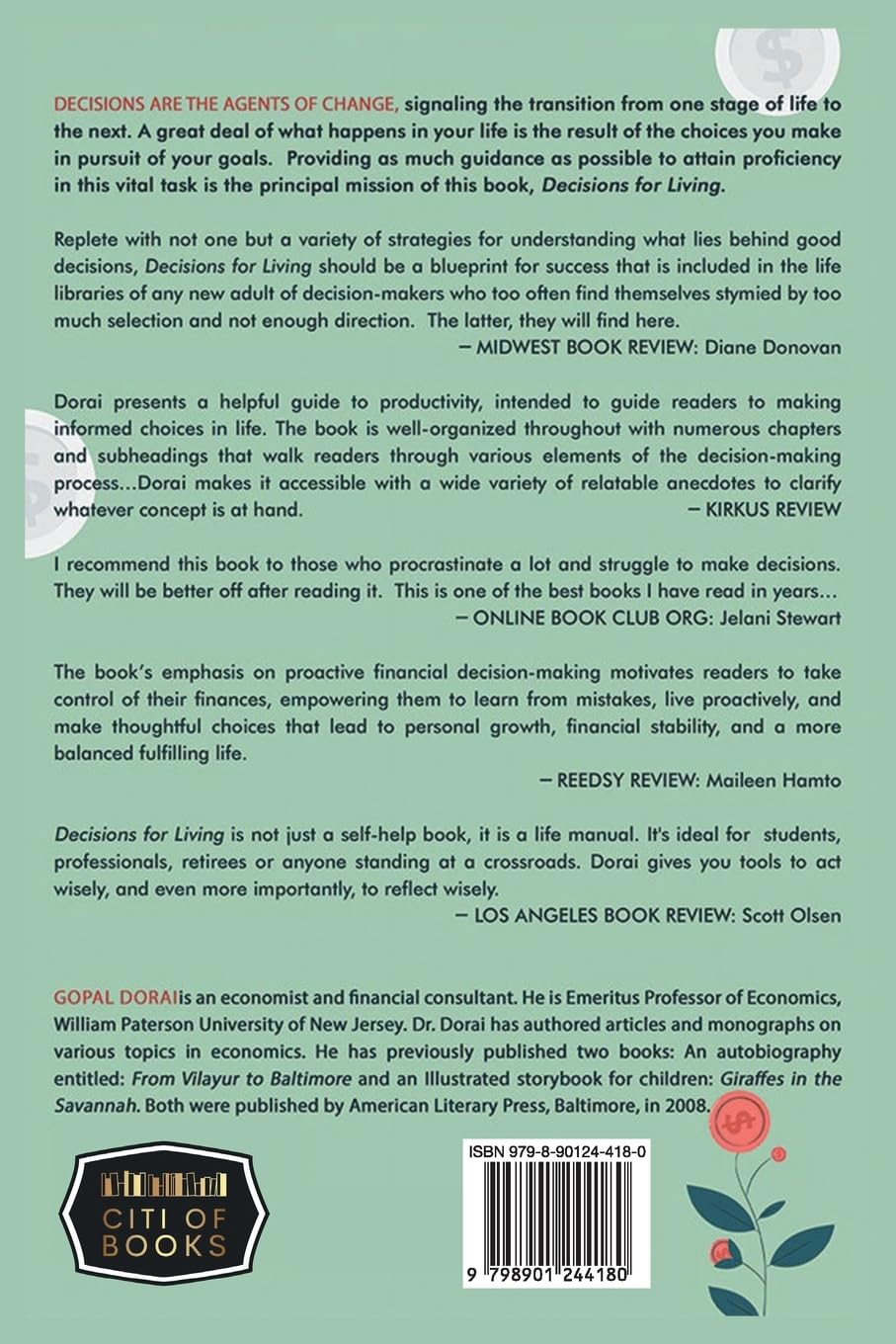
Dorai presents a helpful guide to productivity intended to guide readers to making informed choices in life.

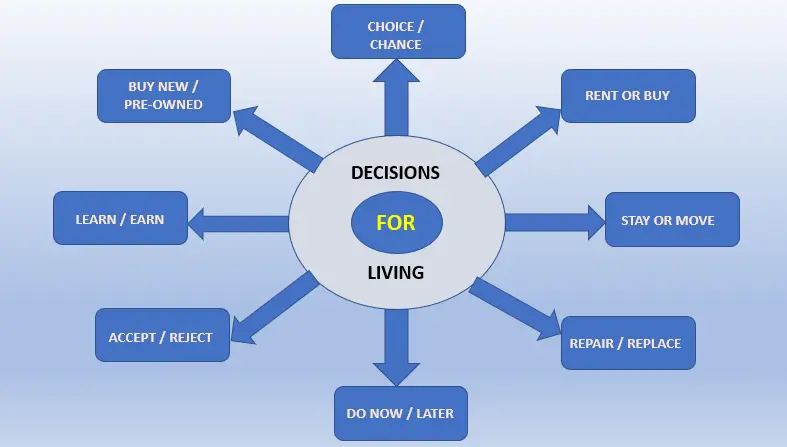
Life is full of big and small decisions, so one must make them with due consideration of their importance. In this self-help book, Dorai, a professor emeritus of economics at New Jersey–based William Paterson University, offers advice on how to make wise choices, drawing on his decades of academic expertise. He includes many graphs and charts along the way, which readers will find quite helpful for processing the concepts and theories he discusses; there’s a clear graph of the average trajectory of income over the course of one’s life, for example, and an image of a table with legs labeled with the four decision-making virtues (“Self-respect, Self-confidence, Self-control, and Self-reliance”). That said, the images’ designs are quite rudimentary, and this lack of visual appeal detracts from the reading experience at times. One of the book’s greatest strengths, though, is its interactive element, which makes it easy to follow. To keep readers engaged, Dorai offers a variety of example questions to ask themselves in personal or professional situations, such as “Who, besides myself, should have input and responsibility for this decision, and for its implementation?” or “Are there ‘short-cuts’ to some decisions? Can the process be simplified?” The book is well-organized throughout, with numerous chapters and subheadings that walk readers through various elements of the decision-making process, such as when to complete a task and when to delegate it. Although the work is arranged very much like an academic thesis, Dorai makes it accessible with a wide variety of relatable anecdotes to clarify whatever concept is at hand.

A straightforward and practical self-help guide, hampered slightly by bland graphics.


Ready to Decide Better? Contact Me.

Your journey to smarter decisions starts with a simple message. I’d love to connect.